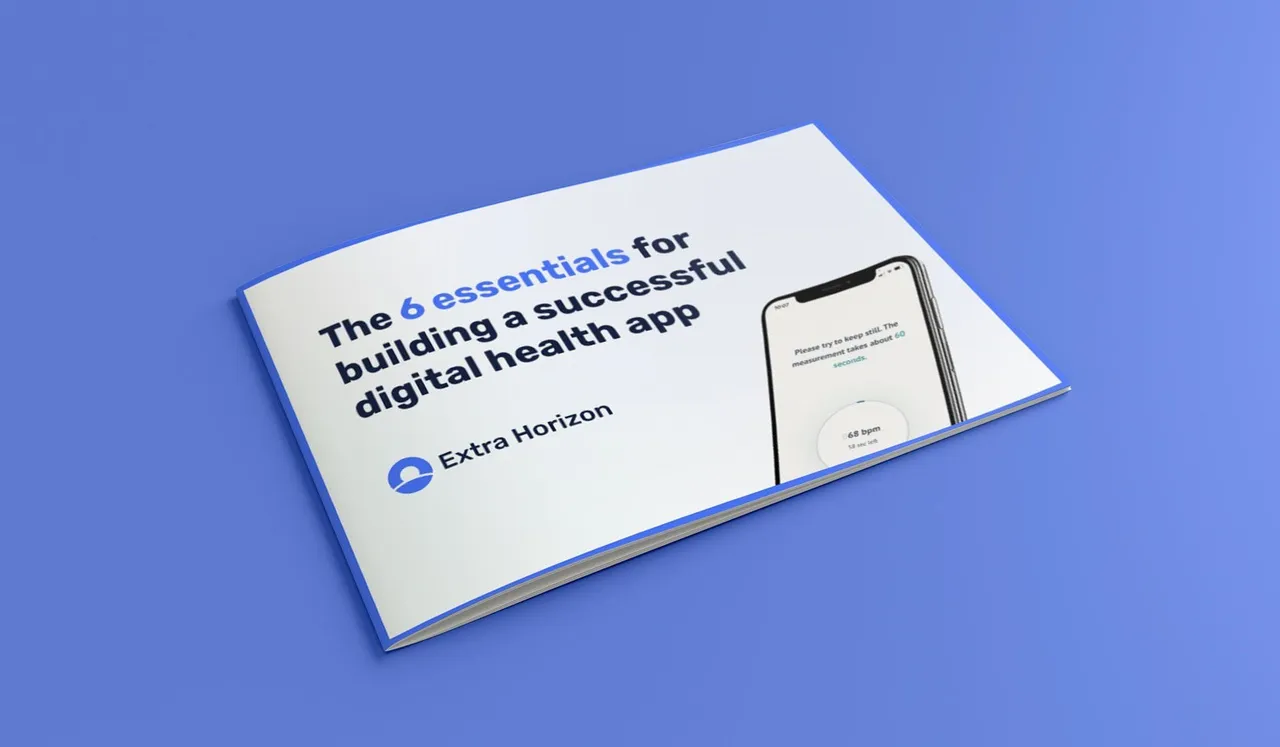
The Six Essentials to Building a Successful Digital Health Application
From architecture choices to regulatory positioning — the six things every digital health team needs to get right before launch.
Building a digital health application is more than writing code. This ebook explores the six essentials that digital health companies need to have in place to build and successfully deploy their product — illustrated through the real-world example of FibriCheck, a heart-monitoring app with over 800,000 users across 40 countries, built on the Extra Horizon platform.
The six essentials
1. A compliant, scalable backend
The backend is the foundation everything else is built on. For a digital health application, that foundation needs to be:
- IEC 62304 compliant — with a documented software lifecycle and traceable requirements
- GDPR and HIPAA ready — with data residency controls, consent management, and audit trails built in
- Scalable by design — capable of handling growth from hundreds to millions of users without re-architecture
Building this from scratch is expensive, slow, and risky. Understanding when to buy vs. build is the first critical decision every medtech team faces.
2. Regulatory strategy from day one
Regulatory compliance is not something you bolt on at the end. The classification of your software (SaMD class, MDR risk class, FDA device class) determines your entire development and documentation strategy. Getting this wrong means expensive rework — or worse, a failed submission.
This section covers how to set your regulatory strategy early, including how to structure your technical file and what evidence you need to gather throughout development.
3. Data architecture and privacy
Patient data is at the heart of every digital health application. How you collect, store, transmit, and process that data determines your compliance posture across every market you want to enter. This section covers:
- Data minimisation and purpose limitation
- Consent flows and revocation
- Cross-border data transfer mechanisms
- Pseudonymisation and encryption at rest and in transit
4. Clinical validation
A medical claim requires clinical evidence. Whether you’re pursuing CE marking under MDR or FDA 510(k) clearance, you need a clinical evaluation strategy — and the earlier you plan for it, the less painful and expensive it will be.
This section outlines the key activities: literature review, clinical investigation planning, and post-market clinical follow-up (PMCF).
5. Security by design
Cybersecurity is now a regulatory requirement, not just best practice. Both the FDA and EU MDR explicitly require medical device software to be developed with security in mind. This section covers:
- Threat modelling during design
- Security testing (SAST, DAST, penetration testing)
- Vulnerability disclosure and patching processes
- Relevant standards: IEC 81001-5-1, AAMI TIR57
6. Go-to-market readiness
Technical and regulatory readiness are necessary but not sufficient. This section covers what it takes to actually go to market: post-market surveillance planning, customer onboarding, SLA commitments, and how to structure commercial agreements that don’t create regulatory liability.
Who is this ebook for?
This guide is written for founders, CTOs, product managers, and regulatory leads at digital health startups and medtech companies who are building or scaling a regulated software product — and want a practical, strategic framework to do it right.
Download free eBook
Fill in the form and receive the eBook straight to your inbox.